

The Invisible Line Between Coping and Overwhelm
Summary: If you have ever felt like somedays you can handle the hard stuff and other days you cannot, you are likely experiencing shifts in what therapists call your window of tolerance, the zone in which your nervous system feels calm, present, and able to cope. This post explains what the window of tolerance is, why it narrows during stress and trauma, and how nervous system regulation, emotional regulation, and trauma therapy such as EMDR can help you widen your window so you feel steady more often, not just on your best days.
What Is the Window of Tolerance?
The term "window of tolerance" was coined by psychiatrist Dr. Dan Siegel to describe the zone of arousal in which a person can function most effectively. When you are inside your window, your nervous system feels balanced. You can think clearly, feel your emotions without being overwhelmed by them, connect with others, and respond to stress instead of simply reacting to it.
When you are pushed outside that window, your nervous system tips into one of two states:
Hyperarousal, where you feel anxious, panicked, irritable, on edge, or unable to slow down
Hypoarousal, where you feel numb, shut down, foggy, disconnected, or exhausted
Neither state are bad. They are cues for us to recognize. Both are your nervous system's attempt to protect you, even when that protection no longer fits the moment you are in.
Why Your Window Might Feel Narrower Than It Used To
If you live with anxiety, depression, chronic stress, a history of trauma, or experience something that is too much to cope with, your window of tolerance may be narrower. A dysregulated nervous system often develops as a natural, adaptive response to real experiences of stress, danger, or unpredictability, especially early in life.
This is important to understand because it means the goal is not to force yourself to "just calm down." The goal is to gently widen your window over time so more of daily life feels manageable, and fewer things knock you out of your zone of tolerance in the first place.
The Elements of Your Window of Tolerance
Understanding your own window starts with recognizing its different parts.
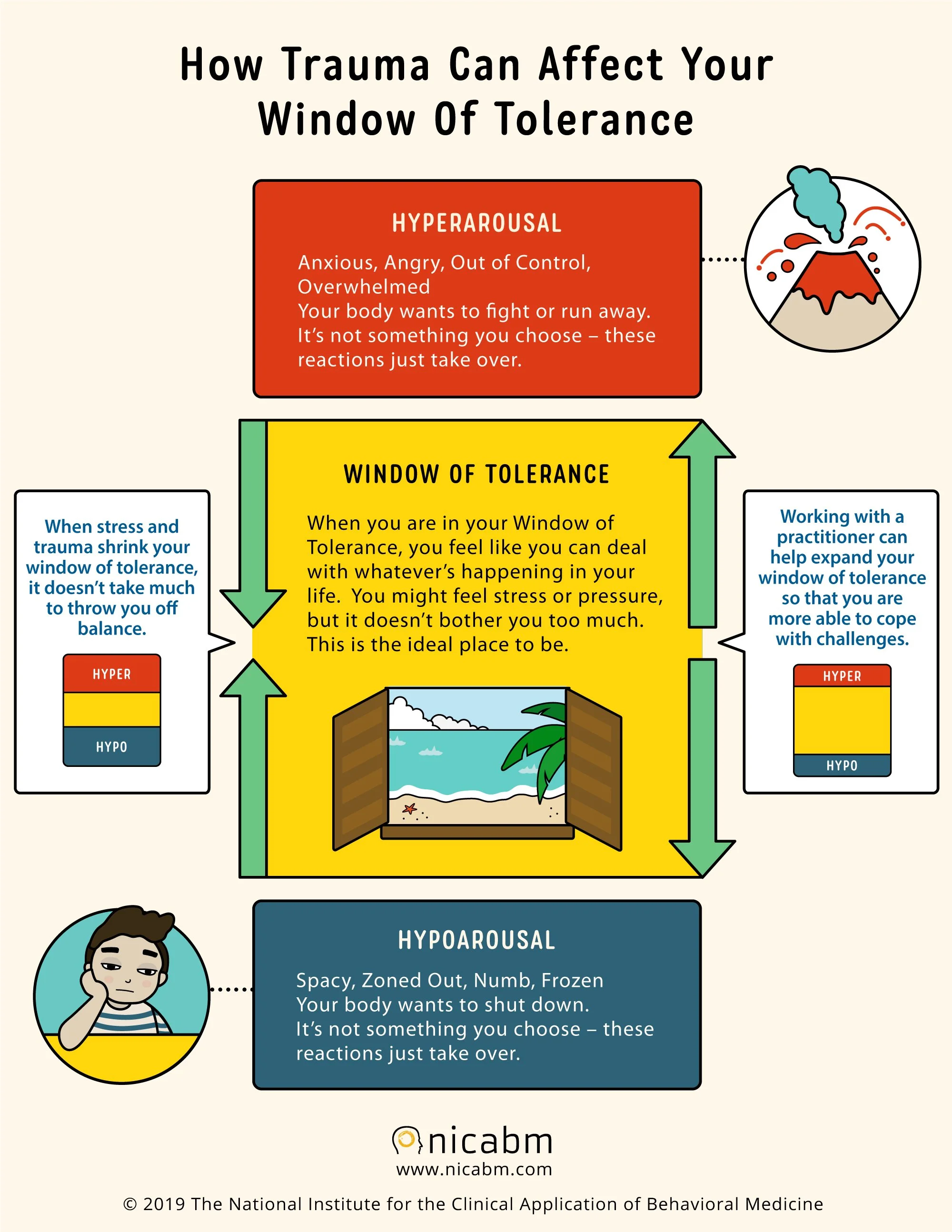
The Hyperarousal Zone (Too Much)
This is the "too much" edge of your window. Common signs include:
Racing thoughts or a racing heart
Irritability or a short fuse
Panic, restlessness, or an urge to escape
Difficulty sitting still or sleeping
Window of Tolerance (The Optimal Zone)
This is the middle ground where you feel grounded and capable. You can experience stress, sadness, or frustration without being consumed by it. Emotional regulation feels more accessible here, and you can think before you react.
The Hypoarousal Zone (Too Little)
This is the "too little" edge of your window. Common signs include:
Numbness or emotional flatness
Fatigue that sleep does not fix
Difficulty concentrating or feeling present
A sense of disconnection from your body or surroundings
National Institute for the Clinical Application of Behavioral Medicine. (n.d.). How to help your clients understand their window of tolerance [Infographic]. https://www.nicabm.com/trauma-how-to-help-your-clients-understand-their-window-of-tolerance/
Window Shrinkers
Certain situations, memories, sensations, or even tone of voice can narrow your window in an instant. Learning your personal shrinkers is a form of nervous system regulation in itself, because awareness gives you a chance to respond before you are fully outside your window.
Window Wideners
Just as some things narrow your window, others expand it. Sleep, nourishment, movement, supportive relationships, and trauma therapy can all gradually widen the space where you feel okay.
How to Recognize Your Own Window
Recognizing your window is less about labeling yourself and more about getting curious.
You might ask yourself:
What does it feel like in my body when I am inside my window?
What are my early signs of things being “too much”, like a clenched jaw or shallow breathing?
What are my early signs of things being “too little”, like zoning out or feeling heavy?
What tends to push me outside my window, and what tends to bring me back?
Keeping a simple log of your emotional states throughout the day can make these patterns easier to see. Over time, this kind of self-awareness becomes one of the most powerful stress management tools available, because you cannot regulate what you cannot recognize.
Nervous System Regulation: Bringing Yourself Back to Center
Nervous system regulation is the practice of helping your body return to its optimal zone when you notice you have drifted into hyperarousal or hypoarousal.
A few gentle starting points:
If you are in hyperarousal (too much):
Slow, extended exhales to activate your body's calming response
Grounding through the five senses, naming what you see, hear, and feel
Cool water on your hands or face
Gentle movement to discharge excess energy, like walking or shaking out your hands
If you are in hypoarousal (too little):
Gentle, rhythmic movement to bring energy back online
Orienting to the room by looking around and naming objects
Warmth, like a blanket or a warm drink
Connecting with a comforting person or pet
These are not quick fixes, and that is okay. Emotional regulation is a skill that builds with repetition.
Why EMDR Can Help Widen Your Window
Eye Movement Desensitization and Reprocessing, or EMDR, is a form of trauma therapy that helps the brain reprocess distressing memories so they no longer trigger the same intensity of hyperarousal or hypoarousal. Unlike approaches that rely heavily on talking through every detail of a painful experience, EMDR works with the brain's natural information processing system, often making it feel more approachable for people who find traditional talk therapy overwhelming.
Over the course of treatment, many clients find that:
Memories that once triggered panic or shutdown start to feel more neutral
Their baseline sense of calm in daily life improves
They develop real, usable coping skills for moments of stress
Their overall nervous system resilience grows, meaning it takes more to knock them out of their window, and less time to return to it
This is one of the most meaningful benefits of EMDR therapy. It does not just help you cope with symptoms in the moment. It works toward natural emotional healing at the root, so your window of tolerance can genuinely widen over time rather than you simply getting better at managing a narrow one.
Building Real-World Coping Skills
Widening your window of tolerance is not only about big therapeutic breakthroughs. It also comes from small, consistent choices:
Building a predictable rhythm to your day, including sleep and meals
Practicing regulation skills before you are in crisis, not only during one
Noticing and naming emotions instead of pushing them away
Allowing yourself compassion when you do get pushed outside your window, rather than judgment
Stress management is not about eliminating stress from your life. It is about building a nervous system that can meet stress, move through it, and come back to center.
Frequently Asked Questions
-
The window of tolerance is the zone where a person can think clearly, feel emotions without being overwhelmed, and respond to stress rather than react to it. Trauma therapy, including EMDR, is often used to help widen this window over time.
-
A narrow window of tolerance means it takes less stress to push someone into anxiety, panic, numbness, or shutdown. This is common after chronic stress, trauma, anxiety, or depression, and it can improve with nervous system regulation and trauma-informed care.
-
You can widen your window of tolerance through consistent nervous system regulation practices, emotional regulation skills, healthy sleep and movement, supportive relationships, and trauma therapy such as EMDR, which helps the brain reprocess distressing memories at the root.
-
EMDR therapy helps the brain reprocess distressing or traumatic memories so they no longer trigger intense hyperarousal or hypoarousal. Over time, this builds nervous system resilience, making it easier to stay within your window of tolerance during everyday stress.
-
Yes. Virtual therapy, including online EMDR sessions, can effectively build emotional regulation and stress management skills from the comfort of home.
-
MindWell, LLC offers virtual therapy, including EMDR, for clients located in Colorado, Florida, and Maine. Online sessions make it possible to access trauma-informed, evidence-based care no matter where you live in these states.
-
If you notice you swing between feeling anxious or on edge and feeling numb or shut down, struggle to manage stress that others seem to handle more easily, or feel like small things push you into big reactions, trauma therapy can help you understand and regulate your nervous system so you feel steadier more often.
You Deserve a Wider Window
If you recognize yourself in this post, whether it is the anxious edge of hyperarousal, the heavy fog of hypoarousal, or the exhausting feeling of never quite knowing which one you will get, please know that this is workable. A narrow window of tolerance is not a life sentence. With trauma therapy, nervous system regulation practices, and support, real change is possible.
If you are ready to explore what a wider window could feel like in your own life, consider reaching out to a licensed therapist trained in EMDR. You do not have to figure this out alone, and you do not have to stay stuck in survival mode. Support is available, and healing is possible.

About the Author
Matthew Schilz, MSW, MPH, LCSW is a licensed therapist with over 3 years of experience supporting clients in Colorado, Maine, and Florida. He specializes in trauma, grief and loss, men’s mental health, and people-pleasing, and uses evidence-based approaches like EMDR to help clients reach their goals. He is committed to providing compassionate online care to clients across Colorado, Maine, and Florida.